Cootings Machine
Klara and the SunThe Cootings Machine is a smoke-producing roadworks machine whose pollution makes the environment itself an active force in the story. Its three funnels darken the sky, obscure the Sun’s patterns, and threaten the nourishment Klara believes artificial friends receive from sunlight; later, the machine becomes the target of her attempt to secure the Sun’s special help for Josie. Its eventual destruction does not end the pollution: a second, larger machine reveals how little a single victory can guarantee.
Appearance and First Encounter
Before the machine arrives, the street has already been transformed by preparation. Overhaul men mark out a section with wooden barriers, drawing the taxi drivers’ angry honking; they then drill and break up the road and parts of the sidewalk. The noise frightens the two artificial friends in the store window, and Rosa covers her ears even while customers are present. The Manager apologizes to those customers, while one of them points to the work outside and calls pollution dangerous. Klara initially wonders whether the arriving machine might be intended to fight pollution, a hope the sight of it will reverse.
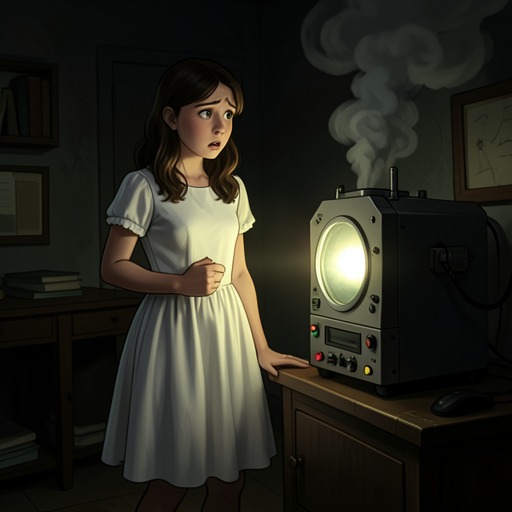
The machine announces itself with a high-pitched whine, which Klara compares with the Manager’s vacuum cleaner and judges less bad than the earlier drilling. Its three short funnels, however, begin to emit small white puffs that gradually darken until they merge into one thick, continuous cloud. Klara gives it the name Cootings Machine after the large letters on its side. The naming fixes attention on a specific piece of equipment, but what matters most in her account is what it does: smoke turns an ordinary street installation into a visible obstruction with consequences reaching far beyond the roadworks site.
Pollution and the Obscured Sun
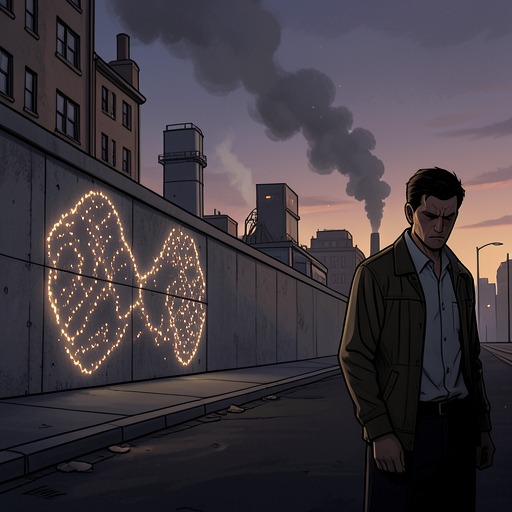
As the smoke accumulates, the pollution changes in both size and trajectory. From the side of the store where magazines are displayed, Klara can no longer see the gap of sky; dirty specks cover the window that glass cleaners had kept proudly clean for the Manager. The roadworks machine does not remain a distant object glimpsed through glass. Its emissions enter the store’s visual world, altering what Klara can see and how she understands the sunlight on which she depends.
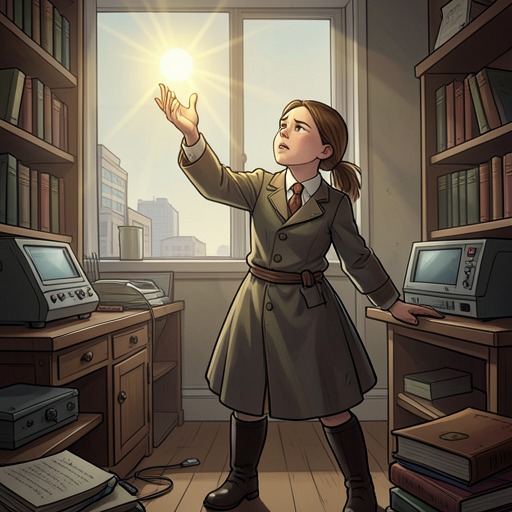
The machine continues operating over successive days, making daytime seem almost like night. Klara searches for the Sun’s patterns on the floor, in the alcoves, and on the walls, but for a time they have disappeared. Late on the second especially bad afternoon, faint patterns return despite smoke that seems worse than before. Klara worries that the store may no longer receive all its nourishment. The Manager tells her the machine has been there several times before and nobody in the store has suffered, advising her to put it out of mind; the reassurance contrasts with Klara’s close attention to the missing light and her conviction that the Sun is trying his utmost.
When the machine and its specially marked-off worksite disappear, the pollution clears, the gap of sky returns brilliant blue, and sunlight pours into the store. The change is public as well as personal: taxis move smoothly again, their drivers are happy, and runners pass smiling. Klara has also been worrying that Josie might have tried to return to the store but been prevented by the pollution. The clearing briefly intensifies that hope; by mid-afternoon, she recognizes that it was unreasonable and turns her attention back to learning about the outside world. The episode links environmental change to both the routine movement of the city and Klara’s private expectations.
From Recollection to Bargain
Later, when Klara tries to understand why the Sun gave special nourishment to Beggar Man and his dog, she recalls the pollution episode as part of the sequence. The machine had forced even the Sun to retreat for a time; after it went away, the Sun was relieved and happy, and gave Beggar Man his special help. In Klara’s interpretation, the return of sunlight is therefore not merely a change in weather or visibility. The machine’s departure marks a renewed relationship between the Sun and the world around it, one that may include acts of care.
That belief gives the remembered machine a new purpose. Klara tells the Sun that she has seen and identified the device responsible for pollution and proposes finding and destroying it. In return, she asks the Sun to consider giving special help to Josie. The bargain makes the machine the concrete object through which Klara tries to act on her faith: instead of only hoping for intervention, she offers to remove what she believes saddens and angers the Sun. When Klara and the Father later encounter a pollution-producing machine used by overhaul men, she recognizes it from the earlier sight near the store. The account thus carries the street’s disturbance into a later, deliberate undertaking.
Destruction and Recurrence
Klara and the Father locate a machine protected from traffic by overhaul men’s barriers, pumping pollution from three funnels. The Father explains that its middle-market Sylvester broad generation unit is fuel-efficient and robust, but lacks real protections. Although it can withstand dust, smoke, and rain, a high-acrylamide substance such as P-E-G Nine solution would overwhelm it: the solution would rapidly polymerize, and the resulting damage would likely be terminal. Klara agrees to try. The machine’s vulnerability turns her proposed act into a technically specific plan rather than a symbolic gesture, and the little fizzing sound later serves as confirmation that it will not rise again.
Klara reports to Rick that the task she had been given, after he helped her reach Mr McBain’s barn, has been completed. Yet the apparent success is short-lived. While travelling with the Mother and the Father, Klara sees another pollution-producing machine by the road and recognizes it before she can read its name. Its three funnels continue the same work as the first. The machine’s recurrence makes her first reaction one almost like kindness toward the terrible object, coming just after her surprise at finding the old store changed. Josie explains that when she had once come looking for Klara, she feared the store might have disappeared, along with Klara and her friends.
Later, looking through a gap between vehicles, Klara sees a machine in its own protected space behind barriers, with the first letters of Cootings visible on its body. She is disappointed, then notices that it is not the one she and the Father destroyed in the yard: it is a different shade of yellow, slightly larger, and produces more pollution than the first. The distinction overturns her assumption that destroying the identified machine could put an end to the pollution. Her later appeal to the Sun acknowledges the second machine and her failure to anticipate it; she insists that the Father did his utmost and that Josie is innocent, while renewing her request for the Sun’s help. She also says she willingly gave up precious fluid and would have given more, showing how the failed effort has involved personal cost as well as disappointment.
Material Force and Limits of Control
The machine’s significance lies in its blunt physical effects. Smoke hides the sky, dirties the store window, changes daylight into something near night, and interrupts the light patterns that Klara reads as nourishment. Barriers, drilling, fumes, and traffic place the machine within a network of work and movement; the people around it can complain, observe, or attempt to disable it, but its effects do not depend on their intentions. In this sense, the machine is more than a backdrop to Klara’s spiritual interpretation: its emissions materially constrain what she can see and shape the actions she takes.
At the same time, Klara’s account gives the pollution an explicitly spiritual meaning. She understands the Sun as capable of being saddened, angered, relieved, and generous, and treats the machine’s disappearance as connected to the Sun’s special help. The second machine tests that understanding without erasing her faith. Her plan succeeds against one machine, but the pollution continues; the difference in color, size, and output makes recurrence legible as a material fact rather than a vague setback. The machine therefore joins environmental obstruction to the story’s questions about agency: Klara can identify a source and act against it, yet neither her effort nor the Sun’s apparent response gives her command over the wider conditions threatening Josie.